Servicing6 min read
Signs your clutch is going, and what replacing it involves
Revs rising without the car speeding up, a biting point that has crept to the top of the pedal, a judder pulling away. Here is what each one means, and what the job actually involves.
By Kaine Carter
A clutch is a wear part, like brake pads. Every time you pull away, the friction plate grips the flywheel and loses a little material. How long that lasts depends far more on how and where the car is driven than on its mileage — town driving and towing wear one out much faster than motorway miles.
1. Slipping
The clearest sign. Accelerate hard in a high gear and the revs climb while the speed barely changes, as if the engine has briefly come unhooked from the wheels. It shows first going uphill or overtaking, when the clutch is asked to carry the most. Once it starts, it progresses — and a clutch slipping badly can leave you unable to pull away at all.
2. A biting point that has moved
If the clutch only starts to bite with the pedal almost all the way up, the friction plate is thin. The point where it bites moves gradually, so it is easy to adapt without noticing. If somebody else drives your car and comments on it, take that seriously.
3. Judder pulling away
A shudder through the car as the clutch engages, worst in first and reverse. It can come from contamination on the friction plate, a worn plate, or — very often on modern diesels and many petrol cars — a failing dual-mass flywheel.
4. Noise when you press or release the pedal
A whirr or rumble that changes when you press the pedal usually points to the release bearing. A rattle or knock at idle that goes away when the pedal is pressed is a common sign of a worn dual-mass flywheel.
5. Trouble selecting gears, or a pedal that feels wrong
Grinding into gear, or a pedal that has gone heavy, spongy or stays down, can be the clutch itself or the hydraulics that operate it. The hydraulics are a smaller job, which is why it is worth having it diagnosed rather than assuming the worst.
What a dual-mass flywheel is, and why it matters
Many cars, and most diesels, have a dual-mass flywheel — two halves joined by springs that soak up engine vibration. It wears too, and when a clutch is replaced it is checked. If it has gone, it is replaced at the same time: the gearbox has to come out to reach either, so doing them together saves paying for that labour twice.
This is the main reason clutch prices vary so much between cars. A conventional flywheel and a clutch kit is one price; a dual-mass flywheel on top can more than double the parts bill. A proper quote tells you which your car has before anything is ordered.
How a clutch is replaced on your driveway
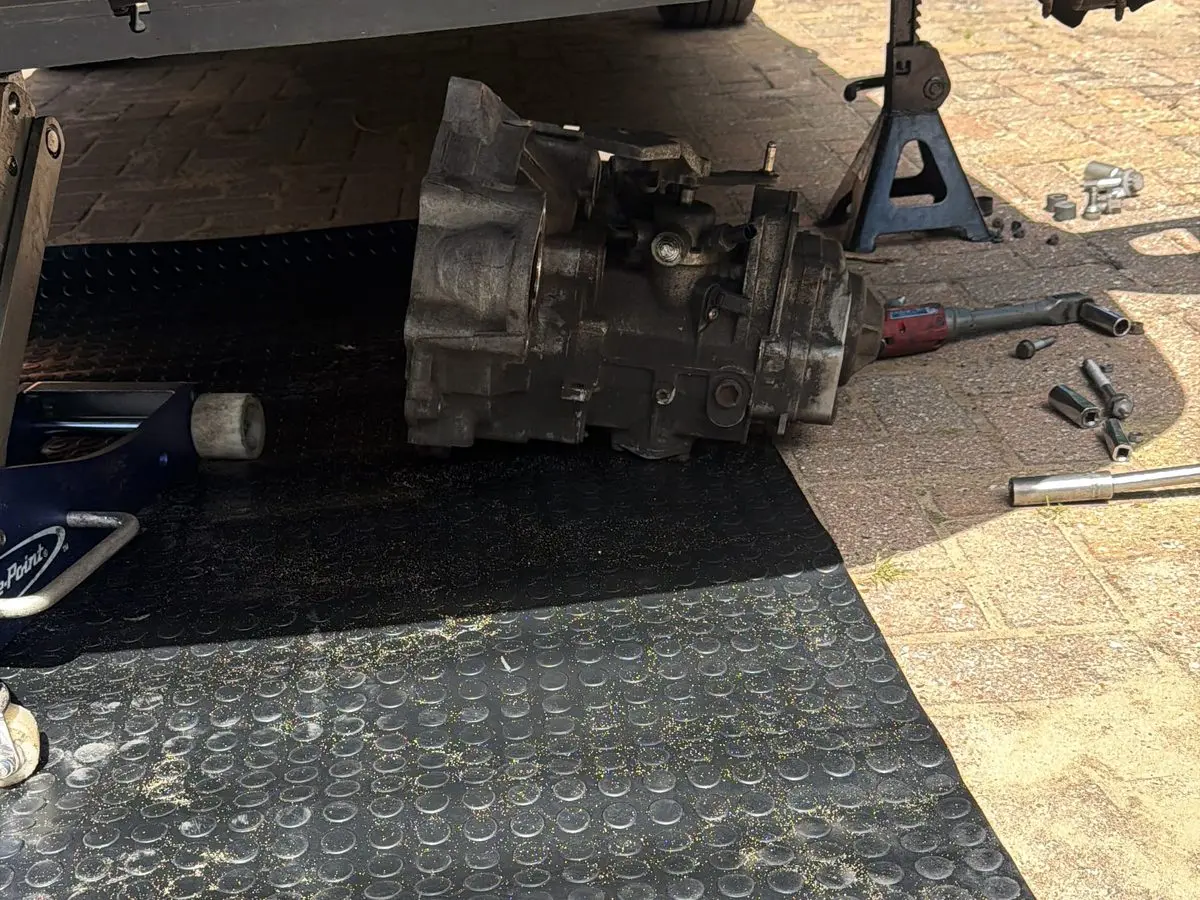
The gearbox comes out from under the car, the old clutch and release bearing come off, the flywheel is inspected, and the new parts go in before the gearbox goes back and the clutch is adjusted and road tested. The photo above is exactly that, on a customer's drive.
- We need a flat, firm space beside the car — a driveway, or a car park where the work is allowed.
- It is a full day's job on most cars, so we book the whole day.
- Clutch replacement starts from £349. You get a written price from the registration before any parts are ordered, including whether the flywheel needs doing.
- Like all our mechanical work, it is done at your address in Milton Keynes, Leighton Buzzard, Bedford, Buckingham and Northampton, with a £60 call-out.
Can you make a clutch last longer?
Mostly by not riding it. Resting a foot on the pedal, holding the car on the clutch on a hill instead of using the handbrake, and slipping it to creep in traffic all wear the plate. Pulling away in second, or towing near the car's limit, does too.